Filter by

Relativity and the Question of Discretization in Astronomy
This work discusses the application of relativity theory in astronomical modeling and examines whether physical quantities in astrophysical systems may require discretization instead of continuous representation.
- Edition
- (Not provided)
- ISBN/ISSN
- -
- Collation
- -
- Series Title
- -
- Call Number
- -

Relativity and the Question of Discretization in Astronomy
This work discusses the role of relativity theory in modern astronomy and examines the conceptual and mathematical implications of discretizing continuous spacetime models. It explores whether astronomical phenomena can be modeled using discrete frameworks while remaining consistent with relativistic physics.
- Edition
- (leave blank if not specified)
- ISBN/ISSN
- -
- Collation
- -
- Series Title
- -
- Call Number
- 530.11

astronomy journey to the cosmic frontier
- Edition
- 2
- ISBN/ISSN
- 0 07 233684 6
- Collation
- 641
- Series Title
- -
- Call Number
- 520/f566
- Edition
- 2
- ISBN/ISSN
- 0 07 233684 6
- Collation
- 641
- Series Title
- -
- Call Number
- 520/f566

Black Hole Gravitohydro-Magnetics
This book provides a theoretical framework for the study of the interaction between black holes and magnetized plasmas. It is an essential resource for researchers involved in black hole physics, relativistic magnetohydrodynamics, and high-energy astrophysics
- Edition
- 2nd Edition (or 1st Edition if not otherwise indic
- ISBN/ISSN
- 3-540-41466-5 (This corresponds
- Collation
- xiv, 432 pages : illustrations ; 24 cm
- Series Title
- Astrophysics and Space Science Library ; Vol. 235
- Call Number
- 523.01 (or use your library classification system
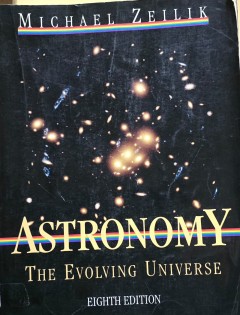
The Evolving Universe
This classic introductory textbook provides an up-to-date overview of astronomical concepts, the structure and evolution of the universe, and the tools used to explore space. Suitable for students and general readers
- Edition
- 9th Edition
- ISBN/ISSN
- 9780521812983
- Collation
- xix, 620 pages; illustrations (some color), maps; 28 cm
- Series Title
- -
- Call Number
- -
 Computer Science, Information & General Works
  Philosophy & Psychology
  Religion
  Social Sciences
  Language
  Pure Science
  Applied Sciences
  Art & Recreation
  Literature
  History & Geography