Filter by

Richard Brauer: Collected Papers. Volume I, Theory of Algebras, and Finite Gr…
First volume of Richard Brauer’s collected papers, covering theory of algebras and finite groups. Edited by Paul Fong and Warren J. Wong. Published by The MIT Press in 1980.
- Edition
- Not specified
- ISBN/ISSN
- 0-262-09148-X
- Collation
- -
- Series Title
- Richard Brauer: Collected Papers; Volume I
- Call Number
- 510 B825

Schaum’s Outline of Theory and Problems of First Year College Mathematics
Covers college algebra, plane trigonometry, plane and solid analytic geometry, and introduction to calculus. Includes 1850 solved problems. Published as part of Schaum’s Outline Series in Mathematics by McGraw-Hill Book Company.
- Edition
- Not specified
- ISBN/ISSN
- 07-002650-5
- Collation
- -
- Series Title
- Schaum’s Outline Series in Mathematics
- Call Number
- 510 A985

Aspects of Mathematics and Its Applications
Collection of papers written in honour of Leopoldo Nachbin. Published as volume 34 of the North-Holland Mathematical Library. Includes bibliographical references. ISBN shown in the book: 0-444-87727-4.
- Edition
- Not specified
- ISBN/ISSN
- 0-444-87727-4
- Collation
- -
- Series Title
- North-Holland Mathematical Library ; 34
- Call Number
- 510 A838

Concepts from Tensor Analysis and Differential Geometry
A work on tensor analysis and differential geometry, published as Volume 1 of the Mathematics in Science and Engineering series by Academic Press in 1965.
- Edition
- Second edition
- ISBN/ISSN
- -
- Collation
- Not available
- Series Title
- Mathematics in Science and Engineering ; Volume 1
- Call Number
- -

Calculus and Analytic Geometry
A widely used calculus textbook covering differential and integral calculus with analytic geometry, authored by Thomas and Finney; fifth edition with a fifth printing in June 1981.
- Edition
- Fifth edition
- ISBN/ISSN
- ISBN 0-201-07540-7
- Collation
- Not available
- Series Title
- Not available
- Call Number
- 515.7 T 459

Projective Plane Geometry
This book introduces the fundamentals of projective plane geometry, covering key concepts such as points at infinity, projective transformations, and invariants. It is intended for undergraduate mathematics students.
- Edition
- First Edition
- ISBN/ISSN
- 69-10047
- Collation
- viii, 180 pages : illustrations ; 24 cm (estimated standard format for this edition)
- Series Title
- Not in a series
- Call Number
- 516.5 B644
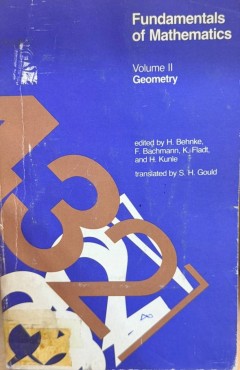
Fundamentals of Mathematics. Volume II: Geometry
A comprehensive treatment of Geometry, covering classical and modern topics with rigorous exposition, intended for advanced students.
- Edition
- First MIT Press paperback edition
- ISBN/ISSN
- 0-262-52094-X
- Collation
- xvi, 500 pages : illustrations ; 24 cm
- Series Title
- Fundamentals of Mathematics ; volume II
- Call Number
- 516 F 981

Foundations of Geometry: Selected Proceedings of a Conference
This volume contains selected papers from a conference held at the University of Toronto (1974), focusing on foundational issues in Geometry, including axiomatic systems and logical structures.
- Edition
- First Edition
- ISBN/ISSN
- 0-8020-2216-2
- Collation
- x, 250 pages : illustrations ; 24 cm
- Series Title
- -
- Call Number
- 516 F 764
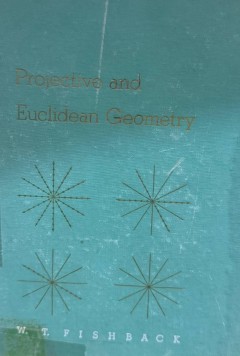
Projective and Euclidean Geometry
This book presents the fundamental principles of both projective and Euclidean geometry, highlighting their relationships and differences. It is suitable for students seeking a solid foundation in Geometry, with emphasis on structure, proofs, and geometric reasoning.
- Edition
- -
- ISBN/ISSN
- 62-20162
- Collation
- x, 350 pages : illustrations ; 24 cm
- Series Title
- [Not part of a series]
- Call Number
- 516.2 F 532

Foundations of Euclidean and Non-Euclidean Geometry
This book provides a rigorous introduction to the foundations of both Euclidean and non-Euclidean geometry. Richard L. Faber develops the axiomatic structure of geometric systems and examines the differences between classical Euclidean geometry and alternative geometries. The text is suitable for advanced students and focuses on logical reasoning, proofs, and the theoretical basis of Geometry.
- Edition
- First Edition
- ISBN/ISSN
- 0-8247-1748-1
- Collation
- xii, 388 pages : illustrations ; 24 cm
- Series Title
- [Not part of a series]
- Call Number
- 516 F 115
 Computer Science, Information & General Works
  Philosophy & Psychology
  Religion
  Social Sciences
  Language
  Pure Science
  Applied Sciences
  Art & Recreation
  Literature
  History & Geography