Filter by

ENCYCLOPEDIA OF INTERNATIONAL MEDIA AND COMMUNICATIONS
- Edition
- 1
- ISBN/ISSN
- -
- Collation
- 4
- Series Title
- -
- Call Number
- -
- Edition
- 1
- ISBN/ISSN
- -
- Collation
- 4
- Series Title
- -
- Call Number
- -

Projective Plane Geometry
This book introduces the fundamentals of projective plane geometry, covering key concepts such as points at infinity, projective transformations, and invariants. It is intended for undergraduate mathematics students.
- Edition
- First Edition
- ISBN/ISSN
- 69-10047
- Collation
- viii, 180 pages : illustrations ; 24 cm (estimated standard format for this edition)
- Series Title
- Not in a series
- Call Number
- 516.5 B644

Success in Chemistry
This book provides a clear and practical introduction to key chemistry concepts, designed to help students build a strong foundation in the subject. It covers essential topics such as atomic structure, chemical bonding, reactions, and basic calculations, using simple explanations and step-by-step examples. The focus is on developing problem-solving skills and understanding rather than memorizat…
- Edition
- First edition
- ISBN/ISSN
- 071952914x
- Collation
- -
- Series Title
- -
- Call Number
- 540 B214
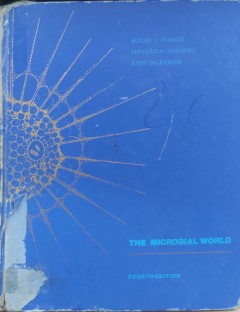
MICROBIAL WORLD
- Edition
- -
- ISBN/ISSN
- -
- Collation
- -
- Series Title
- -
- Call Number
- -
- Edition
- -
- ISBN/ISSN
- -
- Collation
- -
- Series Title
- -
- Call Number
- -
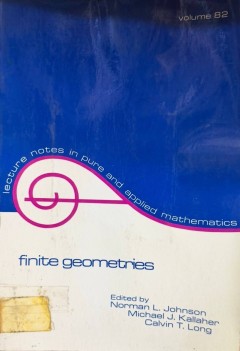
Finite Geometries
This volume contains research papers presented at a conference honoring T. G. Ostrom, focusing on developments in Finite Geometry. Topics include combinatorial structures, projective planes, and applications of finite geometric methods.
- Edition
- First Edition
- ISBN/ISSN
- -
- Collation
- xii, 420 pages : illustrations ; 24 cm
- Series Title
- Lecture Notes in Pure and Applied Mathematics ; v. 82
- Call Number
- 516 F498
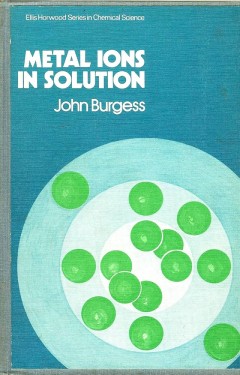
METAL IONS IN SOLUTION
This book explains the behavior of metal ions in aqueous solutions, focusing on their structure, bonding, and reactions. It covers key concepts like coordination chemistry, stability, and interactions with ligands. The text helps students understand how metal ions function in chemical, biological, and environmental systems.
- Edition
- First edition
- ISBN/ISSN
- 0853120773
- Collation
- -
- Series Title
- -
- Call Number
- 541,372 B955

The Chemistry of Organolithium Compounds
Detailed reference on the chemistry, structure, and reactions of organolithium compounds. Includes synthesis methods, properties, and applications in organic chemistry. Suitable for advanced students and researchers.
- Edition
- First edition
- ISBN/ISSN
- 0-08-017640-2
- Collation
- -
- Series Title
- Not specified
- Call Number
- 547.05381 W147
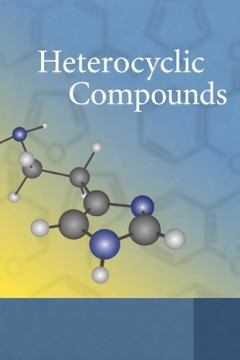
Heterocyclic Compounds
Scientific reference work focusing on the chemistry, synthesis, structure, and applications of 1,2,4-triazoles. Part of The Chemistry of Heterocyclic Compounds series. Series editors: Arnold Weissberger and Edward C. Taylor.
- Edition
- Not specified
- ISBN/ISSN
- 0-471-04656-6
- Collation
- 1 volume ; 24 cm
- Series Title
- The Chemistry of Heterocyclic Compounds
- Call Number
- 547.593 T284

An introduction to organic chemistry
An Introduction to Organic Chemistry by John Read is an early foundational textbook designed to introduce students to the basics of organic chemistry at a time when the subject was still formalizing its educational approach. The book covers essential concepts such as the structure and properties of organic molecules, simple functional groups, and fundamental reactions, presented in a clear desc…
- Edition
- -
- ISBN/ISSN
- -
- Collation
- -
- Series Title
- -
- Call Number
- 547 K28

Photochemistry of man-made polymers
This book explores the effects of light—especially ultraviolet (UV) radiation—on synthetic polymers. It examines the photochemical processes responsible for polymer degradation, including chain scission, oxidation, and cross-linking. The authors discuss the mechanisms of photodegradation, methods for studying these processes, and strategies for improving polymer stability using additives su…
- Edition
- -
- ISBN/ISSN
- -
- Collation
- -
- Series Title
- -
- Call Number
- 547.8427 M154
 Computer Science, Information & General Works
  Philosophy & Psychology
  Religion
  Social Sciences
  Language
  Pure Science
  Applied Sciences
  Art & Recreation
  Literature
  History & Geography